
TIBR4D: Tracing-Guided Iterative Boundary Refinement for Efficient 4D Gaussian Segmentation
Published in ACM Multimedia, 2026
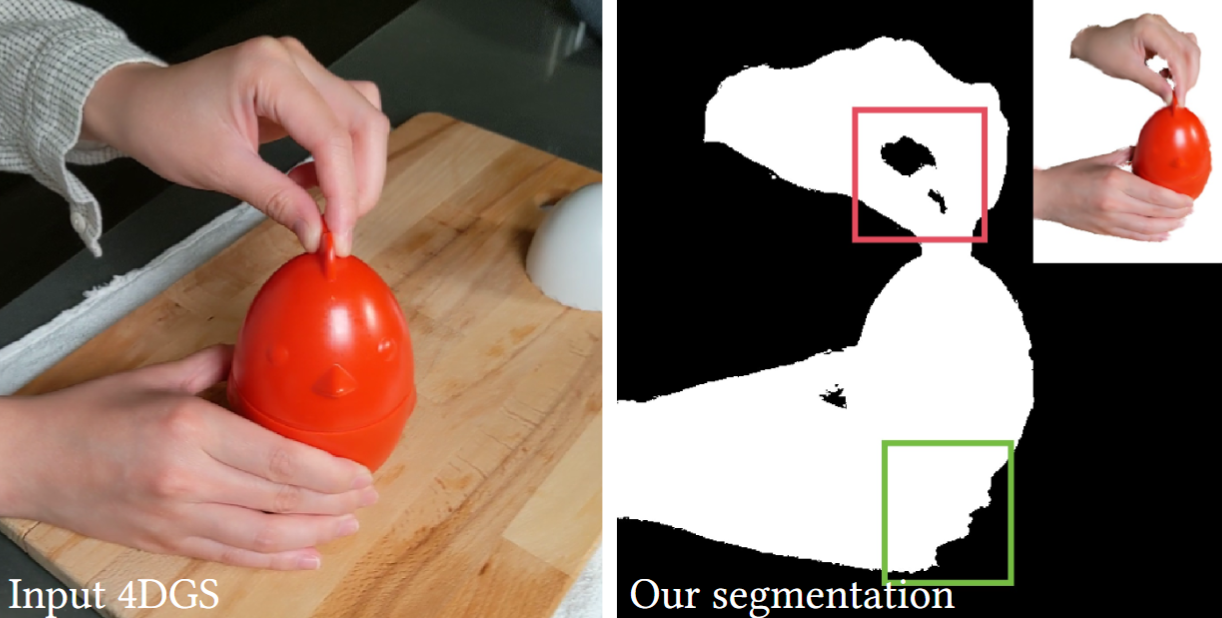
Benefiting from two training-free iterative refinement stages, our method enables efficient extraction of target objects while effectively suppressing floating Gaussians and boundary leakage, resulting in more accurate segmentation.
Abstract: Object-level segmentation in dynamic 4D Gaussian scenes remains challenging due to complex motion, occlusions, and ambiguous boundaries. In this paper, we present an efficient learning-free 4D Gaussian segmentation framework that lifts video segmentation masks to 4D spaces, whose core is a two-stage iterative boundary refinement. The first stage is Iterative Gaussian Instance Tracing (IGIT) at the temporal segment level. It progressively refines Gaussian-to-instance probabilities through iterative tracing and extracts corresponding Gaussian point clouds. Thus, it can handle occlusions and preserve the completeness of object structures. The second stage is frame-wise Gaussian Rendering Range Control (RRC), which suppresses highly uncertain Gaussians near object boundaries while retaining their core contributions for more accurate boundaries. Furthermore, a temporal segmentation strategy is proposed for IGIT to balance identity consistency and dynamic awareness. Correlations within each temporal segment enforce strong multi-frame constraints for stable identities, while independence across segments allows identity changes to be captured promptly. Experiments on HyperNeRF and Neu3D datasets demonstrate that our method produces clearer segmented Gaussian point clouds with accurate boundaries and achieves higher efficiency compared to SOTA methods.
Recommended citation: He Wu, Xia Yan, Yanghui Xu, Liegang Xia, Jiazhou Chen. “TIBR4D: Tracing-Guided Iterative Boundary Refinement for Efficient 4D Gaussian Segmentation.” ACM Multimedia. 2026.